
June 27, 2026
10:00 AM
IMPORTANT
Please create a Microsoft Teams account prior to registering for the course.
Please note that all our live webinars are presented at the Eastern Standard Time Zone (EST).
Please check the time in your city, state, province, and country that corresponds to EST.
These webinars constitute to 2.5 CEU credits each.
All content of this webinar series is accepted as Category A credit toward recertification by The Hand Therapy Certification Commission (HTCC).
Abstract
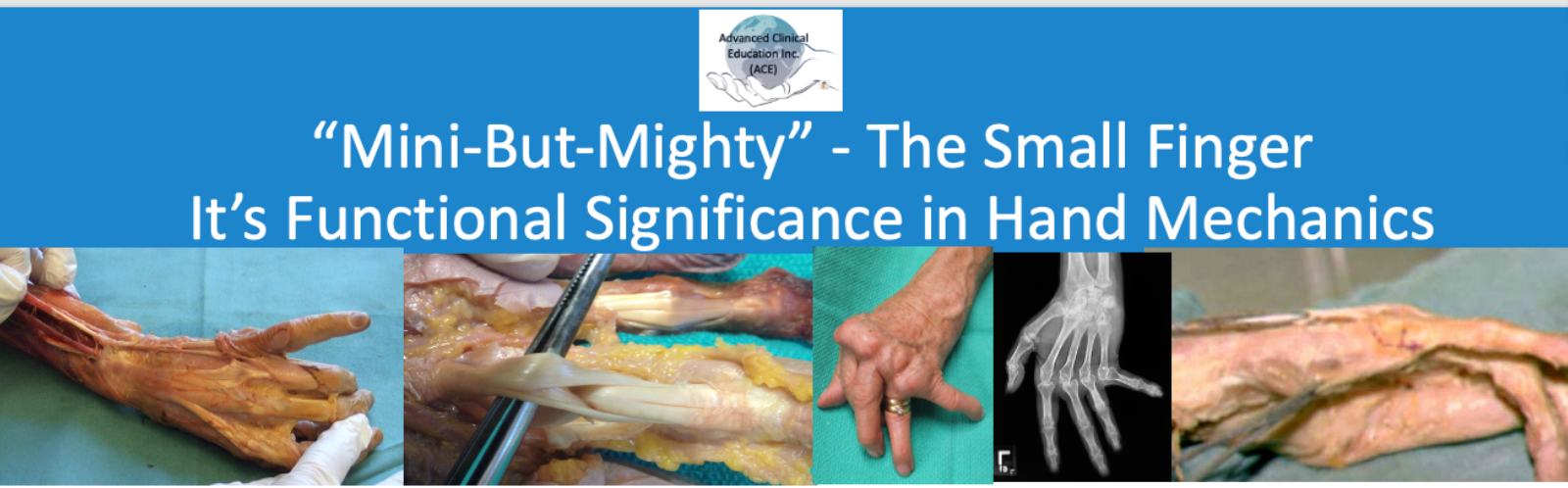
Although often considered the least important digit, the small finger plays a crucial role in overall hand function. Located at the ulnar border of the hand, it contributes significantly to grip strength, hand cupping, and object stabilization. Its articulation with the mobile fifth carpometacarpal joint and coordinated intrinsic and extrinsic muscle activity allow the hand to conform to objects of varying shapes, enhancing the effectiveness of power grip, particularly in cylindrical and spherical grasp patterns.
Biomechanically, the small finger increases the contact surface of the hand and stabilizes the ulnar column, thereby augmenting grip force. Loss or impairment of the small finger can substantially reduce grip strength and compromise functional tasks such as tool use, carrying objects, and forceful grasping. Working in synergy with the ring finger, it supports the balance between the radial precision pinch unit and the ulnar power grip unit.
Clinically, injuries to the small finger—including fractures, tendon disruptions, nerve injuries, and joint instability—can significantly impair overall hand performance. Such conditions may reduce the hand’s ability to cup and conform to objects, leading to diminished grip efficiency, coordination, and dexterity. Consequently, preservation of small finger alignment, mobility, and neuromuscular function is essential in both surgical management and rehabilitation.
Despite its small size, the small finger is functionally “mighty,” playing a vital role in grip strength, hand stability, and coordinated hand use. Recognition of its importance is critical for clinicians managing hand injuries and restoring optimal hand function.
Learning Objectives