
April 17, 2026
IMPORTANT
Please create a Microsoft Teams account prior to registering for the course.
Please note that all our live webinars are presented at the Eastern Standard Time Zone (EST).
Please check the time in your city, state, province, and country that corresponds to EST.
These webinars constitute to 2.5 CEU credits each.
All content of this webinar series is accepted as Category A credit toward recertification by The Hand Therapy Certification Commission (HTCC).
Abstract
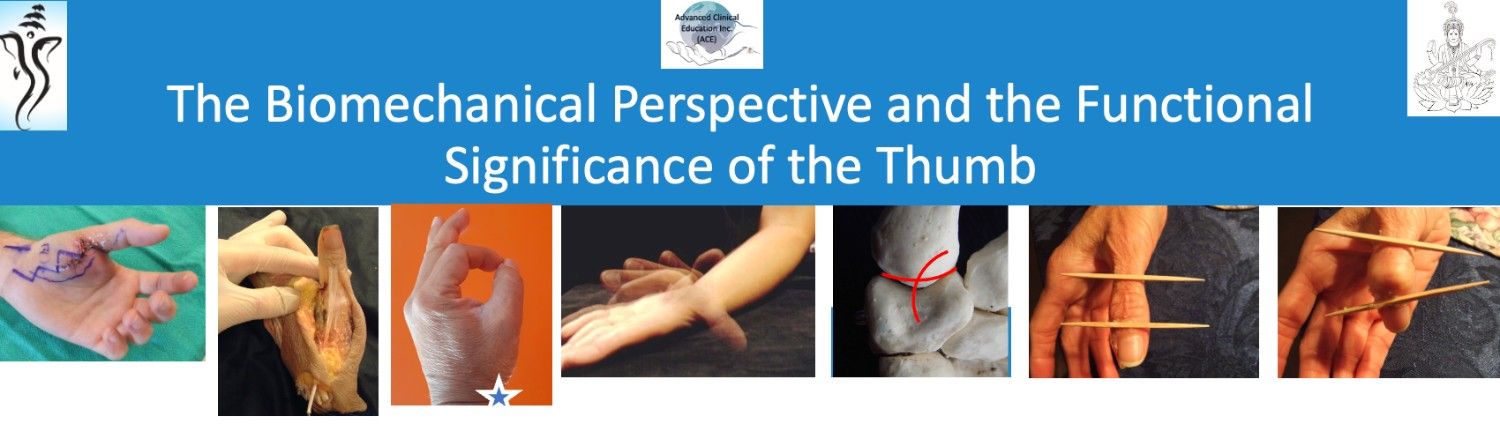
The thumb plays a critical role in hand function, contributing disproportionately to dexterity, grip,
strength, and precision. Its unique anatomy, particularly the highly mobile carpometacarpal
(CMC) joint, allows multiplanar movements including flexion, extension, abduction, adduction,
and opposition.
These motions enable the thumb to work in coordinated opposition with the fingers, forming the biomechanical basis for both precision pinch and power grip.
Through the balanced action of intrinsic thenar muscles and extrinsic tendons, the thumb generates controlled forces necessary for object manipulation and stabilization.
Because of this biomechanical advantage, the thumb is estimated to contribute nearly half of the functional capacity of the hand.
Injuries such as fractures, ligament disruptions, tendon injuries, nerve damage, or degenerative conditions like carpometacarpal arthritis can significantly impair thumb mobility and stability.
Such disruptions compromise pinch strength, opposition, and grasp efficiency, ultimately affecting the functional performance of the entire hand.
Understanding the biomechanics and functional importance of the thumb is therefore essential for effective clinical management and rehabilitation aimed at restoring optimal hand function.
Learning Objectives