May 23, 2026
10:00 AM
IMPORTANT
Please create a Microsoft Teams account prior to registering for the course.
Please note that all our live webinars are presented at the Eastern Standard Time Zone (EST).
Please check the time in your city, state, province, and country that corresponds to EST.
These webinars constitute to 2.5 CEU credits each.
All content of this webinar series is accepted as Category A credit toward recertification by The Hand Therapy Certification Commission (HTCC).
Abstract
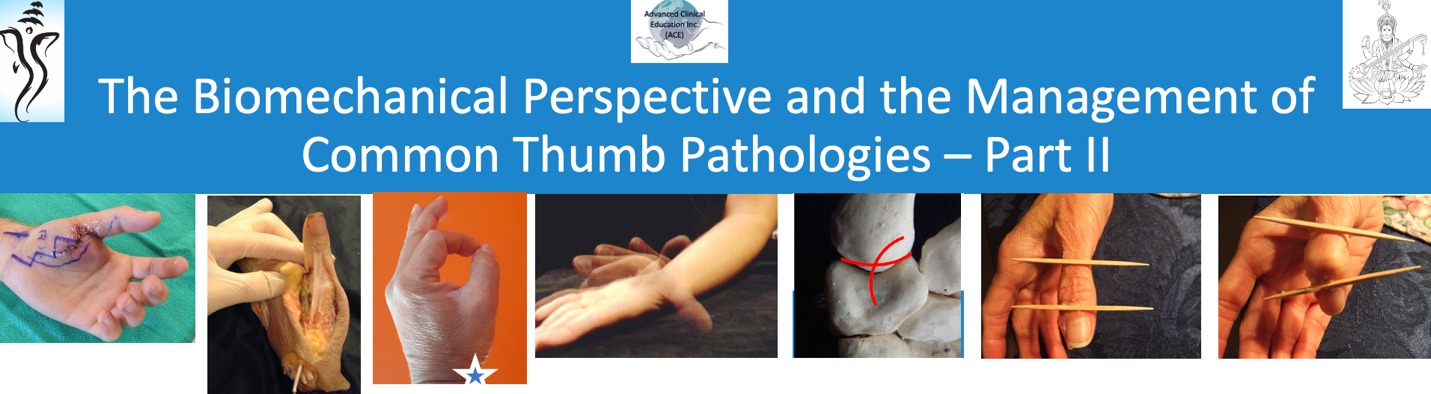
The thumb plays a pivotal role in hand function, contributing to grip strength, precision pinch,
and overall dexterity through its unique anatomy and biomechanics. Its multiplanar mobility,
governed by the coordinated action of intrinsic and extrinsic musculotendinous units, renders it
particularly susceptible to a spectrum of pathologies. Tendon injuries, including flexor pollicis
longus and extensor pollicis longus disruptions, compromise force transmission and coordinated
motion. Cumulative trauma disorders, often arising from repetitive loading and overuse, lead to
tendinopathy and functional impairment.
Degenerative conditions, particularly osteoarthritis of the trapeziometacarpal joint, significantly
affect thumb stability and pinch mechanics. Ligamentous injuries, such as ulnar collateral
ligament insufficiency at the metacarpophalangeal joint, result in instability and diminished
functional capacity. Fractures involving the metacarpal and phalanges further disrupt structural
integrity and biomechanics, often necessitating precise management to restore alignment and
motion. Additionally, nerve injuries, including compression neuropathies and traumatic insults,
impair sensory feedback and motor control, further compromising hand function.
A comprehensive understanding of thumb biomechanics is essential for accurate diagnosis and
effective management of these conditions. Integrating biomechanical principles into clinical
assessment and treatment strategies enhances functional outcomes and supports evidence-based
rehabilitation.
Learning Objectives